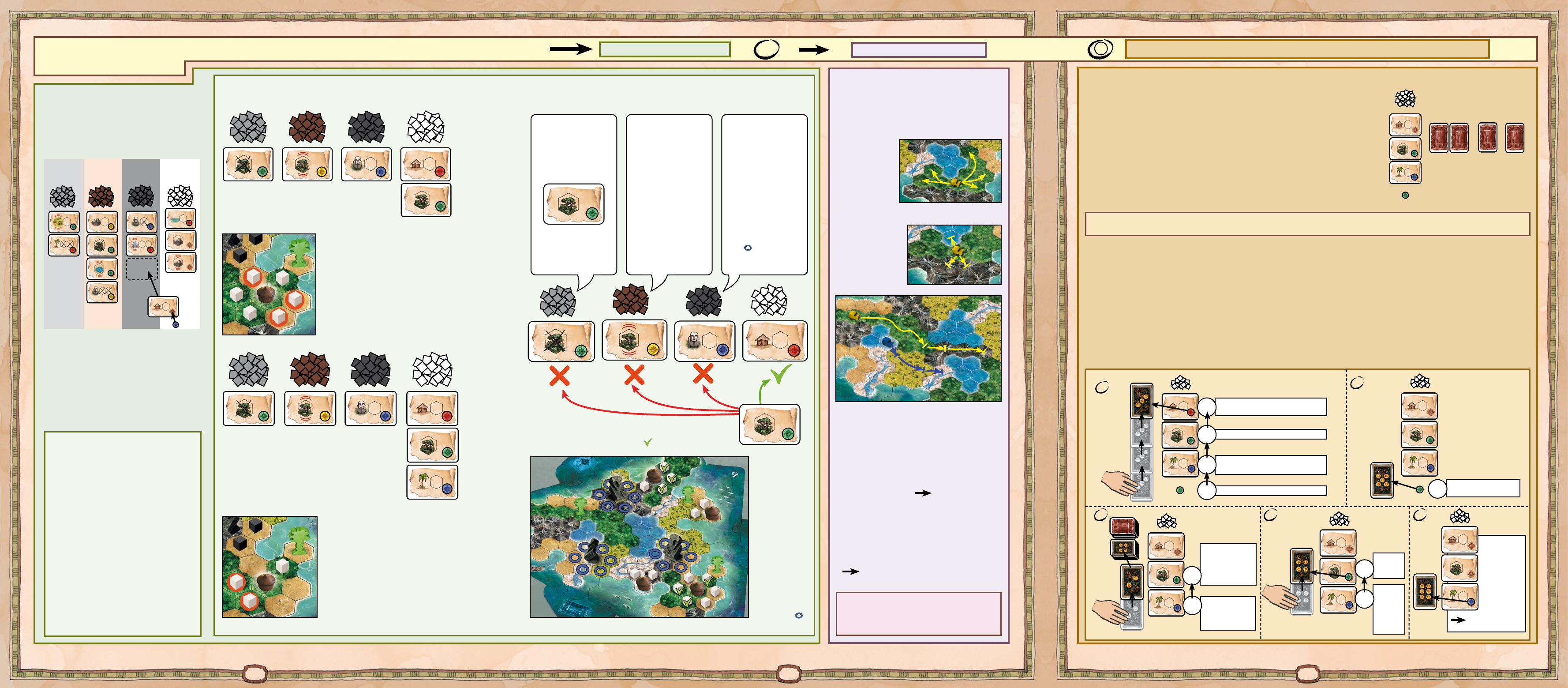
Each treasure map leads to one treasure site. Each
clue of the treasure map eliminates one or more
spaces on the island. The remaining spaces are the
ones where the treasure can still be hidden. Mark
these spaces with the
correspondingly coloured site markers as soon as
it is possible to cover every space with the available
site markers. (Often, it will take several clues to
reach this point.) Afterwards, for each new clue
added to the treasure map, remove the site markers
from the spaces the clue eliminated. The location of
the treasure is determined as soon as only one site
marker of its colour remains on the island. Only
then, can the treasure be raised.
Treasures may also be located on spaces with palm
trees, statues, and huts.
It is possible for site markers belonging to different
treasure maps to share the same space on the island.
ATVs can enter any space on the island, even if it
contains a palm tree, a hut, a statue, or other ATVs.
ATVs cannot enter the ocean.
2) Changing the terrain2) Changing the terrain
Moving into an
adjacent adjacent
space space
of a
differentdifferent
terrain type (e.g. from
the jungle to the
adjacent lake space).
A) Play a clue cardA) Play a clue card
• Must allow at least one
site where the treasure
could still be hidden, a
trea sure cannot simply
“vanish from the
island”.
Rules for adding cluesRules for adding clues
The brownbrown treasure is located
in the largest jungle.
AnnaAnna
cannot add the clue “In the
jungle” to this treasure map
either, as it does not reduce
the possible sites for the
treasure’s location.
AnnaAnna finally adds the clue “In the jungle” to the
whitewhite
treasure
map, hereby reducing the possible spaces for the treasure’s location.
Of the former 14 sites, only 6
remain (see example).
When adding a clue to a treasure map the clue …
• must reduce thepossible
sites where the trea sure
could be hidden by at
least one space.
• must not contradict any
clue already present in
the treasure map.
B) Move your ATVB) Move your ATV
You can move your ATV
up to 3 legs.up to 3 legs.
The following counts as
oneone
leg:
1) Moving within a terrain1) Moving within a terrain
Any movement
within the same within the same
terrain type, terrain type,
no
matter how far.
Each clue eliminates spaces as possible treasure locationsEach clue eliminates spaces as possible treasure locations
Special Cases:Special Cases:
• When raising a treasure ( Page 4), any unused
legs of your movement (towards the treasure) expire.
In case your ATV is already located at the exact treasure
location at the beginning of your turn, you may raise
the treasure and afterwards decide if you would like to
perform Action A) or Action B).
• Collecting an amulet automatically ends a leg.
Page 5
Two examples of how you can drive the 3 legs:
LolaLola
uses the first leg to drive to the end of the jungle. Changing
to the mountains uses up her second leg. With the third leg she
can, at most, reach the end of the mountains.
BobbyBobby first leg takes him from the lake to the adjacent scrubland
space. He crosses the scrub land in the second leg. Then, he
reaches the adjacent river space in the third leg.
Looking at the
situation in this
example reveals
why
AnnaAnna cannot
add the clue “In
the jungle” to the
blackblack
treasure
map: None of the
jungle spaces lies
next to a statue
.
Then, draw a replacement card from the clue card
deck. Your hand should always contain 4 cards (6
cards in a two-player game).
Anna adds the clue “In the jungle” to the
treasure map in the
whitewhite
treasure area. Accordingly, the
whitewhite
treasure is located next to a hut and in the jungle.
This eliminates all spaces which, though next to a hut, are
not part of a jungle.
The example to the left shows the situation at
oneone
of the four huts.
Around each of the four huts, all
whitewhite
site markers notnot located in the jungle are removed.
After BobbyBobby has played his clue, all
whitewhite
site markers
not located next to a palm tree are
removed.removed.
Now, BobbyBobby also adds the clue “Next to a palm tree” to
the treasure map in the
whitewhite
treasure area. Therefore,
only spaces that are next to a hut, and next to a palm tree,
and in the jungle still qualify as possible locations for this
treasure.
The
blackblack
treasure is
located next to a statue.
If none of the spaces next
to the statues is in the
jungle
(as in the example
below),
AnnaAnna cannot add
this clue here either.
AnnaAnna cannot add the clue
“In the jungle” to the
treasure map in the
greygrey
treasure area, as the first clue
already rules out the jungle.
Not in the
jungle
In the largest
jungle
Next to
a statue
Next to
a hut
In the
jungle
If the clue card deck is depleted, shuffle the discarded clue cards to
form a new deck. (You can find explanations of the clue cards on
the supplementary sheet.)
Choose a clue card from your hand and place it
face-up below the last clue card of one of the treasure
maps. Then, mark the clue card just played with one
of your compass roses.
New clue cards are always placed below the other cards of a
treasure map. A treasure map may contain any number of clue
cards from any number of players.
Grey Grey
Treasure Treasure
Area Area
BlackBlack
Treasure Treasure
Area Area
BrownBrown
Treasure Treasure
Area Area
White White
Treasure Treasure
Area Area
You take turns in a clockwise direction, starting with the player who has visited an
island most recently. During your turn, you may perform
oneone
of the following two actions:
A) Play a clue card A) Play a clue card
Caution! Caution!
Don‘t give away what kind of treasure card you have seen. Especially not if you have drawn a curse card. If only you possess certain information
about the contents of the treasure, this will give you an advantage when it comes to the distribution of the treasure.
That is why it is offered to BobbyBobby, but he
passes, too.
AnnaAnna is asked again, but declines again.
RogerRoger could pass, too, but he takes the
card and is given back his compass rose.
AnnaAnna passes on the first treasure card.
1.
2.
3.
4.
AnnaAnna takes the second
treasure card right away.
Although BobbyBobby
is the only one
left to claim the
last treasure card,
it is shown to all
players,
none theless.
Then,
BobbyBobby
starts a new
treasure map.
Page 5
BobbyBobby
passes on
the last
but one
trea-sure
card.
AnnaAnna
takes the
card.
1.
2.
Example:
BobbyBobby is offered
the third treasure
card, but he politely
declines.
AnnaAnna does not want
the card either.
Therefore, this
treasure card is
discarded.
1.
2.
1.
I. The TreasuresI. The Treasures
11
22
33
44
55
+
At any time during your turn, you may, if possible, raise
treasurestreasures
(I) and/or play one or more
amuletsamulets
(II).
a) Raising a Treasurea) Raising a Treasure
You can raise a treasure if these two conditions are met:
1) The exact location of the treasure is defined, i.e. only one site marker of the treasure remains on the
game board.
2) It is your turn and your ATV reaches (or already occupies) the space containing the remaining site
marker.
To raise the treasure, place one of your compass roses below the last clue card of the corresponding
treasure map. Then, remove the site marker and put it back on its pile.
Now, each of you draws as many treasure cards as you have compass roses lying on (or below) the
treasure map. After secretly looking at them, hand the treasure cards face down to the player who will
distribute the treasure cards.
AnnaAnna has raised the treasure. She
draws two treasure cards, as she has
two compass roses on the treasure
map.
RogerRoger and BobbyBobby draw one
card each.
AnnaAnna RogerRoger BobbyBobby
b) Distributing a Treasureb) Distributing a Treasure
Without looking at it, the player distributing the treasure draws an additional card from the treasure deck and adds it to the cards received from the other
players. After the cards have been shuffled thoroughly, the topmost treasure card is displayed face-up, and all players with compass roses on the treasure
map are asked in the sequence of the compass roses -- from bottom to top (beginning with the player who raised the
treasure) -- whether they want to claim the treasure card or not.
1) The owner of the lowest compass rose on or below the treasure map is asked first, whether she wants the treasure card. If she declines, the owner of the
next higher compass rose is asked (even if the player has been asked before), and so on.
2) Whoever claims a treasure card takes the card and places it face down in front of him, and is given back the compass rose that he used to claim the
treasure card. Treasure cards nobody claimed are placed on the treasure card discard pile.
3) Then, the player distributing the treasure cards turns over the next card and offers it as described above. This is repeated until all the treasure cards for
this treasure have been offered or no compass rose remains on the treasure map. If a treasure card is left over, it is discarded.
22 33 44
B) Move your ATVB) Move your ATV
or
Game Play:



Diskutieren Sie über dieses Produkt mit
Hier können Sie uns Ihre Meinung zu Zoch Tobago mitteilen. Wenn Sie eine Frage haben, lesen Sie zunächst das Bedienungsanleitung sorgfältig durch. Die Anforderung eines Bedienungsanleitung kann über unser Kontaktformular erfolgen.