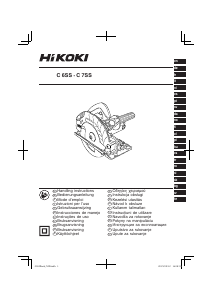
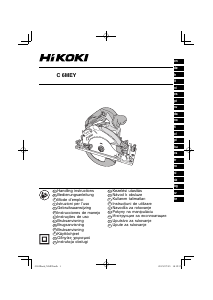
Bedienungsanleitung Hikoki C 6MEY Kreissäge

Benötigen Sie ein Bedienungsanleitung für Ihren Hikoki C 6MEY Kreissäge? Unten können Sie das PDF-Bedienungsanleitung kostenlos auf Deutsch ansehen und herunterladen. Für dieses Produkt gibt es derzeit 3 häufig gestellte Fragen, 0 Kommentare und 0 Stimmen. Wenn dies nicht das von Ihnen gewünschte Bedienungsanleitung ist, kontaktieren Sie uns bitte.

Ist Ihr Produkt defekt und bietet die Bedienungsanleitung keine Lösung? Gehen Sie zu einem Repair Café, wo es gratis repariert wird.

Bedienungsanleitung

Loading…
4
English
ADDITIONAL SAFETY WARNINGS
1. Use only blade diameter speci ed on the machine.
2. Do not use any abrasive wheel.
3. Do not use saw blades which are deformed or cracked.
4. Do not use saw blades made of high speed steel.
5. Do not use saw blades which do not comply with the
characteristics speci ed in these instructions.
6. Do not stop the saw blades by lateral pressure on the
disc.
7. Always keep the saw blades sharp.
8. Ensure that the lower guard moves smoothly and freely.
9. Never use the circular saw with its lower guard xed in
the open position.
10. Ensure that the retraction mechanism of the guard
system operates correctly.
11. Wear earplugs to protect your ears during operation.
12. Never operate the circular saw with the saw blade turned
upward or to the side.
13. Ensure that the material is free of foreign matters such as
nails.
14. The saw blades range should be from 162 mm to
165 mm.
15. Disconnect the plug from the receptacle before carrying
out any adjustment, servicing or maintenance.
16. Be careful of brake kickback.
This circular saw features an electric brake that functions
when the switch is released. As there is some kickback
when the brake functions, be sure to hold the main body
securely.
17. Ensure that the power source to be utilized conforms
to the power requirements speci ed on the product
nameplate.
18. Ensure that the power switch is in the OFF position.
If the plug is connected to a receptacle while the power
switch is in the ON position, the power tool will start
operating immediately, which could cause a serious
accident.
19. When the work area is removed from the power source,
use an extension cord of su cient thickness and rated
capacity. The extension cord should be kept as short as
practicable.
20. Avoid cutting in the state where the base has oated up
from the material.
When blade is binding, or when interrupting a cut for any
reason, release the trigger and hold the saw motionless
in the material until the blade comes to a complete
stop. Never attempt to remove the saw from the work
or pull the saw backward while the blade is in motion or
KICKBACK may occur. Investigate and take corrective
actions to eliminate the cause of blade binding.
21. Support large panels to minimize the risk of blade
pinching and KICKBACK. Large panels tend to sag
under their own weight (Fig. 3). Supports must be
placed under the panel on both sides, near the line of cut
and near the edge of the panel as shown in Fig. 2.
To minimize the risk of blade pinching and kickback.
When cutting operation requires the resting of the saw
on the work piece, the saw shall be rested on the larger
portion and the smaller piece cut o .
22. Use extra caution when making a “Pocket Cut” into
existing walls or other blind areas. The protruding blade
may cut objects that can cause KICKBACK.
NEVER place your hand or ngers behind the saw
(Fig. 4). If kickback occurs, the saw could easily jump
backwards over your hand, possibly causing severe
injury.
23. WARNING: It is important to support the work piece
properly and to hold the saw rmly to prevent loss
of control which could cause personal injury. Fig. 5
illustrates typical hand support of the saw.
24. Place the wider portion of the saw base on that part
of the work piece which is solidly supported, not on
the section that will fall o when the cut is made. As
examples, Fig. 6 illustrates the RIGHT way to cut o the
end of board, and Fig. 7 the WRONG way. If the work
piece is short or small, clamp is down.
DON’T TRY TO HOLD SHORT PLACES BY HAND!
25. Never attempt to saw with the circular saw held upside
down in a vise. This is extremely dangerous and can
lead to serious accidents (Fig. 8).
26. Should lever remain loosened, it will create a very
hazardous situation. Always thoroughly clamp it.
(Fig. 12)
27. It is very hazardous to allow wing bolt to remain loosened.
Always thoroughly clamp it. (Fig. 23)
28. Prior to cutting operation, make sure the material you
are going to cut. If the material to be cut is expected to
generate harmful / toxic dusts, make sure the dust bag
or appropriate dust extraction system is connected with
dust outlet tightly.
Wear the dust mask additionally, if available.
Before starting to saw, con rm that the saw blade
has attained full-speed revolution.
Should the saw blade stop or make an abnormal
noise while operating, promptly turn OFF the switch.
Always take care in preventing the power cord from
coming near to the revolving saw blade.
Using the circular saw with the saw blade facing
upwards or sideways is very hazardous. Such
uncommon applications should be avoided.
When cutting materials, always wear protective
glasses.
When nished with a job, pull out the plug from the
receptacle.
29. After having attached the saw blade, recon rm that the
lock lever is rmly secured in the prescribed position.
30. Do not expose directly your eye to the light by looking
into the light.
If your eye is continuously exposed to the light, your eye
will be hurt.
31. Check that there are no nicks or scratches in the cord.
32. Check the exterior and ensure that there is no damage.
33. Use a saw blade with a displayed rotational speed equal
to or higher than the rotational speed of the tool.
34. Use a saw blade that suits each di erent cutting material.
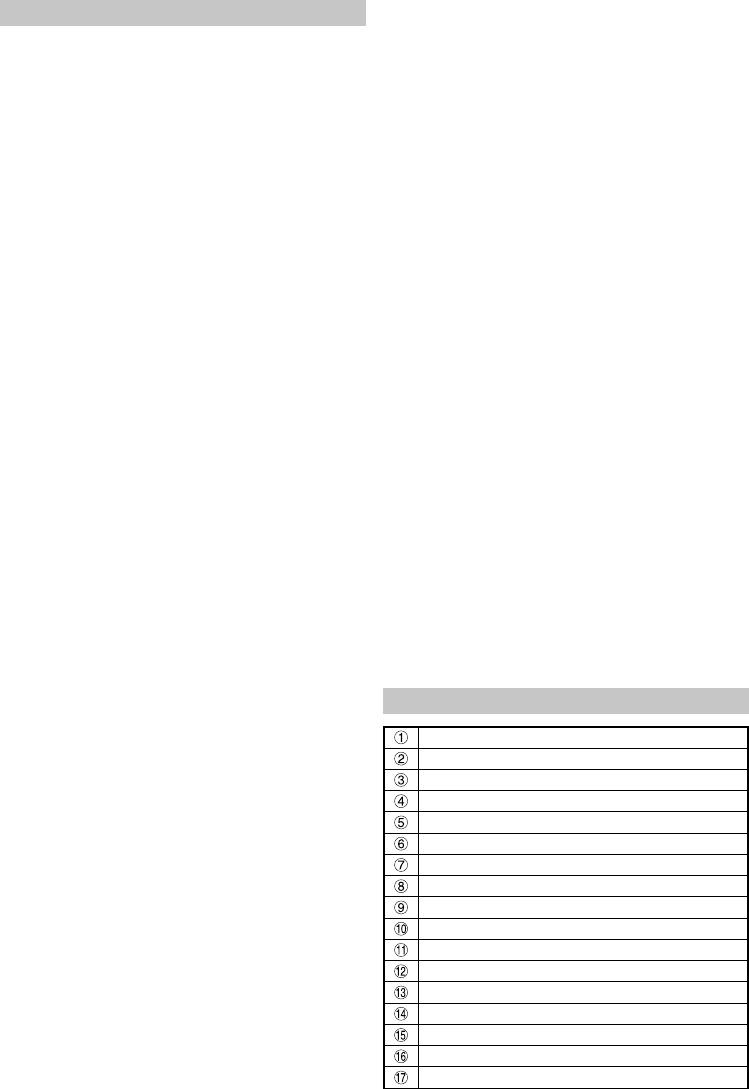
NAMES OF PARTS (Fig. 1 – Fig. 27)
Switch
Switch lock
Cutting depth lever
Incline wing nut
Guide fastener wing bolt
Lower guard
Bolt
Washer (B)
Saw blade
Guide piece
Base
Incline lever
Lock lever
Guide fastener wing bolt
Stopper lever
LED light
Cord holder
0000Book̲C6MEY.indb40000Book̲C6MEY.indb4 2019/07/2518:19:372019/07/2518:19:37
Download Bedienungsanleitung auf Deutsch (PDF, 17.2 MB)
(Denken Sie an die Umwelt und drucken Sie diese Bedienungsanleitung nur aus, wenn es unbedingt nötig ist)

Loading…

Bewertung

Teilen Sie uns mit, was Sie über die Hikoki C 6MEY Kreissäge denken, indem Sie eine Produktbewertung verfassen. Möchten Sie Ihre Erfahrungen mit diesem Produkt teilen oder eine Frage stellen? Hinterlassen Sie einen Kommentar am Ende dieser Seite!
Sind Sie mit Hikoki C 6MEY Kreissäge zufrieden?
Ja Nein
Seien Sie die erste Person, die dieses Produkt bewertet
0 Bewertungen

Diskutieren Sie über dieses Produkt mit

Hier können Sie uns Ihre Meinung zu Hikoki C 6MEY Kreissäge mitteilen. Wenn Sie eine Frage haben, lesen Sie zunächst das Bedienungsanleitung sorgfältig durch. Die Anforderung eines Bedienungsanleitung kann über unser Kontaktformular erfolgen.

Mehr zu diesem Bedienungsanleitung

Wir verstehen, dass es schön ist, ein gedrucktes Bedienungsanleitung für Ihr Hikoki C 6MEY Kreissäge zu haben. Sie können das Bedienungsanleitung jederzeit von unserer Website herunterladen und selbst ausdrucken. Wenn Sie ein Originalhandbuch wünschen, empfehlen wir Ihnen, Hikoki zu kontaktieren. Möglicherweise können sie ein Originalhandbuch bereitstellen. Suchen Sie das Bedienungsanleitung Ihres Hikoki C 6MEY Kreissäge in einer anderen Sprache? Wählen Sie auf unserer Homepage Ihre bevorzugte Sprache und suchen Sie nach der Modellnummer, um zu sehen, ob wir sie verfügbar haben.

Spezifikationen

Marke Hikoki
Modell C 6MEY
Kategorie Kreissägen
Dateityp PDF
Dateigröße 17.2 MB

Alle Anleitungen für Hikoki Kreissägen
Weitere Anleitungen von Kreissägen

Häufig gestellte Fragen zu Hikoki C 6MEY Kreissäge

Unser Support-Team sucht nach nützlichen Produktinformationen und beantwortet Ihre häufig gestellten Fragen. Sollte Ihnen ein Fehler bei den häufig gestellten Fragen auffallen, teilen Sie uns dies bitte anhand unseres Kontaktformulars mit.

Wie viele Millimeter sollte die Säge unter dem Material, das ich säge, hervorragen? Verifiziert

Es ist am besten, mindestens 3 mm hervorragen zu lassen. Wenn es weniger ist, besteht die Möglichkeit, dass das Material bröckelt oder das Ergebnis unsauber wird.

Das war hilfreich (110) Mehr lesen

Muss ich Gehörschutz tragen, wenn ich eine Kreissäge verwende? Verifiziert

Ja, sollten Sie. Auch wenn sich die Lautstärke einer Kreissäge möglicherweise je nach Marke und Modell unterscheidet, kann die Langzeitbelastung durch starken Lärm dauerhafte Gehörschäden verursachen. Aus diesem Grund ist es empfehlenswert, Gehörschutz zu tragen.

Das war hilfreich (53) Mehr lesen

Kann ich Elektrowerkzeuge in einem Schuppen oder einer Garage aufbewahren? Verifiziert

Im Allgemeinen können Sie Elektrowerkzeuge in einem Schuppen oder einer Garage aufbewahren, auch wenn es dort manchmal friert. Für die Lebensdauer des Elektrowerkzeugs ist es jedoch besser, es an einem trockenen Ort ohne große Temperaturschwankungen aufzubewahren. In einem Schuppen oder einer Garage kann es aufgrund von Temperaturunterschieden zur Bildung von Kondenswasser kommen, das Rost verursachen kann. Darüber hinaus halten akkubetriebene Geräte kürzer und laden sich bei sehr niedrigen Temperaturen schlechter auf. Um sicherzugehen, wie Ihr Elektrowerkzeug gelagert werden muss, lesen Sie die Bedienungsanleitung immer sorgfältig durch.

Das war hilfreich (27) Mehr lesen
Bedienungsanleitung Hikoki C 6MEY Kreissäge

Verwandte Produkte

Verwandte Kategorien

×
Download