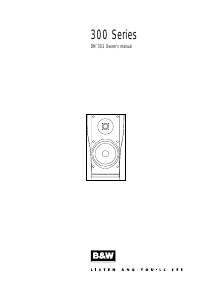
Bedienungsanleitung Bowers and Wilkins DM305 Lautsprecher

Benötigen Sie ein Bedienungsanleitung für Ihren Bowers and Wilkins DM305 Lautsprecher? Unten können Sie das PDF-Bedienungsanleitung kostenlos auf Deutsch ansehen und herunterladen. Für dieses Produkt gibt es derzeit 5 häufig gestellte Fragen, 0 Kommentare und 0 Stimmen. Wenn dies nicht das von Ihnen gewünschte Bedienungsanleitung ist, kontaktieren Sie uns bitte.

Ist Ihr Produkt defekt und bietet die Bedienungsanleitung keine Lösung? Gehen Sie zu einem Repair Café, wo es gratis repariert wird.

Bedienungsanleitung

Loading…

1
INTRODUCTION
Thank you for purchasing B&W DM300 Series
speakers.
Since its foundation in 1966, the continuing
philosophy of B&W has been the quest for
perfect sound reproduction. Inspired by the
companys founder, the late John Bowers, this
quest has entailed not only high investment in
audio technology and innovation but also an
abiding appreciation of music to ensure that
the technology is put to maximum effect.
The rear panel of the DM305 cabinet is
formed into a wedge pattern similar to the
interior of an anechoic chamber. This greatly
helps to break up the regular internal cabinet
volume that would otherwise encourage
coloration from internal standing waves.
Homogeneous fibre cone bass/midrange
drive units are used for minimum coloration
and maximum definition. The DM305 also
features a soft dome tweeter with magnetic
fluid cooling to ensure good definition to the
limits of audibility and maintain dynamics to
high sound levels.
However, no matter how good the speakers
themselves, they must work well into the listening
room and time spent on the installation process
will reap the reward of many hours listening
pleasure. Please read through this manual fully.
It will help you optimise the performance of your
audio system.
B&W distribute to over 50 countries world-wide
and maintain a network of dedicated distributors
who will be able to help should you have any
problems your dealer cannot resolve.
UNPACKING
(figure 1)
Fold the top carton flaps right back and invert
the carton and contents.
Lift the carton clear of the contents.
Remove the inner packing from the product.
4 spike feet and 4 lock nuts are taped in
recesses in one polystyrene end tray.
We suggest you retain the packaging for future
use.
CONNECTIONS
(figure 2)
All connections should be made with the
equipment turned off.
There are two pairs of terminals at the back of
each speaker, one pair to the bass unit and one
pair to the tweeter which permit bi-wiring or bi-
amplification if desired. On delivery, both pairs
are connected together by plated copper links
for use with a single twin cable.
Connect the positive terminal on the speaker
(marked + and coloured red) to the positive
terminal on the power amplifier and negative
(-, black) to negative (figure 2). Failure to
observe correct polarity will result in poor
sound balance and image focusing.
When bi-wiring the speakers, loosen the terminal
caps and remove the links. Use a separate twin
cable from the amplifier terminals to each pair of
speaker terminals (figure 3). Correct polarity
connection is even more critical in this case to
maintain the frequency response of each speaker
as well as the correct balance between left and
right speakers. The use of separate cables can
improve the reproduction of low-level detail by
reducing interaction in the crossover and
allowing optimum choice of cable for each
frequency range.
Always make sure all the terminal caps are
screwed down tight, as otherwise they may
rattle.
When choosing cable, keep the total electrical
impedance (out and back) below the maximum
recommended in the specification. In particular,
the cable to the tweeter should have low
inductance, otherwise the very high frequencies
will be attenuated. Ask your dealer for advice,
as the optimum cable will depend on the length
required.
POSITIONING
(figure 4)
Some experimentation with the position of the
speakers is well worthwhile to optimise the
interaction between them and the listening room.
However, as an initial guide:
Do not fit the spike feet until you have found the
best position for the speakers.
Place the speakers and the centre of the listening
area approximately at the corners of an
equilateral triangle.
Keep the speakers at least 1.5m (5ft) apart to
maintain left-right stereo separation.
Keep the speaker baffles at least 0.5m (20in)
clear of walls. Having the speakers too close
to walls increases the level of bass relative to
the midrange and may give a boomy quality
to the sound.
WARNING: The DM305 produces a static
magnetic field that extends outside the cabinet
boundary. As such The DM305 should not be
placed within 0.5m (20in) of equipment that
may be affected by such a field, e.g. Cathode
Ray Tubes in TVs and Personal Computers.
FINE TUNING
Before fine tuning the installation, double check
the polarity and security of the connections.
If the level of bass is uneven with frequency, this
is usually due to strong excitation of resonance
modes in the room.
Even small changes in the position of the
speakers within the listening room can have a
profound effect on the perceived sound quality
by altering the excitation of these modes. Try
mounting the speakers along a different wall.
Even moving large pieces of furniture about can
have an effect.
If the general level of bass is too high, try
moving the speakers further away from the
walls. Conversely, if you need more bass,
move the speakers closer to the walls.
Space behind the speakers also improves
the impression of perspective on well recorded
material.
If the central image is poor, try moving the
speakers closer together or toeing them in so
they point at or just in front of the listening
area (figure 5).
If the sound is too harsh, increase the amount
of soft furnishing in the room. For example, use
heavier curtains. Conversely reduce the amount
of soft furnishing if the sound is dull and lifeless.
Test for flutter echoes by clapping your hands
and listening for rapid repetitions. These can
smear the sound, but may be reduced by
irregular shaped surfaces such as bookshelves
and large pieces of furniture.
Ensure the speakers stand firmly on the floor.
Whenever possible fit the spike feet supplied
after you have optimised the positioning. These
are designed to pierce through carpeting to the
floor surface. Initially, screw the lock nuts fully
onto the spikes and screw the spikes fully into
the threaded inserts in the base of the cabinet. If
the cabinet rocks, unscrew the two spikes that do
not touch the floor equally until the cabinet sits
firmly on the floor, and lock them in place by
tightening the lock nuts against the cabinet. If
there is no carpet and you wish to avoid
scratching the floor surface, use a protective disc
between the spike and the floor.
AFTERCARE
The vinyl veneers normally only require dusting.
If you wish to use an aerosol cleaner, remove the
grille first by gently pulling it away from the
cabinet. Spray onto the cleaning cloth, not
directly onto the cabinet. The grille fabric may
be cleaned with a normal clothes brush after
removing the grille from the cabinet.
Avoid touching the drive units, especially the
tweeter, as damage may result.
Download Bedienungsanleitung auf Deutsch (PDF, 0.09 MB)
(Denken Sie an die Umwelt und drucken Sie diese Bedienungsanleitung nur aus, wenn es unbedingt nötig ist)

Loading…

Bewertung

Teilen Sie uns mit, was Sie über die Bowers and Wilkins DM305 Lautsprecher denken, indem Sie eine Produktbewertung verfassen. Möchten Sie Ihre Erfahrungen mit diesem Produkt teilen oder eine Frage stellen? Hinterlassen Sie einen Kommentar am Ende dieser Seite!
Sind Sie mit Bowers and Wilkins DM305 Lautsprecher zufrieden?
Ja Nein
Seien Sie die erste Person, die dieses Produkt bewertet
0 Bewertungen

Diskutieren Sie über dieses Produkt mit

Hier können Sie uns Ihre Meinung zu Bowers and Wilkins DM305 Lautsprecher mitteilen. Wenn Sie eine Frage haben, lesen Sie zunächst das Bedienungsanleitung sorgfältig durch. Die Anforderung eines Bedienungsanleitung kann über unser Kontaktformular erfolgen.

Mehr zu diesem Bedienungsanleitung

Wir verstehen, dass es schön ist, ein gedrucktes Bedienungsanleitung für Ihr Bowers and Wilkins DM305 Lautsprecher zu haben. Sie können das Bedienungsanleitung jederzeit von unserer Website herunterladen und selbst ausdrucken. Wenn Sie ein Originalhandbuch wünschen, empfehlen wir Ihnen, Bowers and Wilkins zu kontaktieren. Möglicherweise können sie ein Originalhandbuch bereitstellen. Suchen Sie das Bedienungsanleitung Ihres Bowers and Wilkins DM305 Lautsprecher in einer anderen Sprache? Wählen Sie auf unserer Homepage Ihre bevorzugte Sprache und suchen Sie nach der Modellnummer, um zu sehen, ob wir sie verfügbar haben.

Spezifikationen

Marke Bowers and Wilkins
Modell DM305
Kategorie Lautsprecher
Dateityp PDF
Dateigröße 0.09 MB

Alle Anleitungen für Bowers and Wilkins Lautsprecher
Weitere Anleitungen von Lautsprecher

Häufig gestellte Fragen zu Bowers and Wilkins DM305 Lautsprecher

Unser Support-Team sucht nach nützlichen Produktinformationen und beantwortet Ihre häufig gestellten Fragen. Sollte Ihnen ein Fehler bei den häufig gestellten Fragen auffallen, teilen Sie uns dies bitte anhand unseres Kontaktformulars mit.

Ich möchte einen Lautsprecher mittels HDMI mit meinem Fernseher verbinden. Welchen Anschluss soll ich verwenden? Verifiziert

Sie müssen den HDMI-ARC-Anschluss verwenden, welcher speziell für den Anschluss von Audiogeräten konzipiert wurde.

Das war hilfreich (1480) Mehr lesen

Was sagen die Frequenzen über meinen Lautsprecher aus? Verifiziert

Sie zeigen den Frequenzbereich an, den der Lautsprecher erzeugen kann. Ein größerer Frequenzbereich sorgt für eine größere Variation des Klangbilds und sorgt für eine höhere Klangqualität.

Das war hilfreich (790) Mehr lesen

Wann ist meine Musik zu laut? Verifiziert

Lautstärken über 80 Dezibel (dB) können zu Hörschäden führen. Töne über 120 dB schaden dem Gehör sofort. Wie ernst der Schaden ist, hängt davon ab, wie oft und wie lange die Lautstärke vorherrscht.

Das war hilfreich (472) Mehr lesen

Funktioniert Bluetooth durch Wände und Decken? Verifiziert

Ein Bluetooth-Signal kann durch Wände und Decken empfangen werden, es sei denn diese bestehen aus Metall. Je nach Dicke und Material der Wand kann das Signal schwächer werden.

Das war hilfreich (232) Mehr lesen

Welcher maximale Geräuschpegel ist für Kinder sicher? Verifiziert

Kinder erleiden schneller einen Gehörschaden als Erwachsene. Daher ist es wichtig, Kinder niemals einem Geräuschpegel von mehr als 85 dB auszusetzen. Bei Kopfhörern gibt es spezielle Modelle für Kinder. Bei Lautsprechern oder in anderen Situationen sollten Sie darauf achten, dass der Geräuschpegel diesen Wert nicht überschreitet.

Das war hilfreich (209) Mehr lesen
Bedienungsanleitung Bowers and Wilkins DM305 Lautsprecher

Verwandte Produkte

Verwandte Kategorien

×
Download